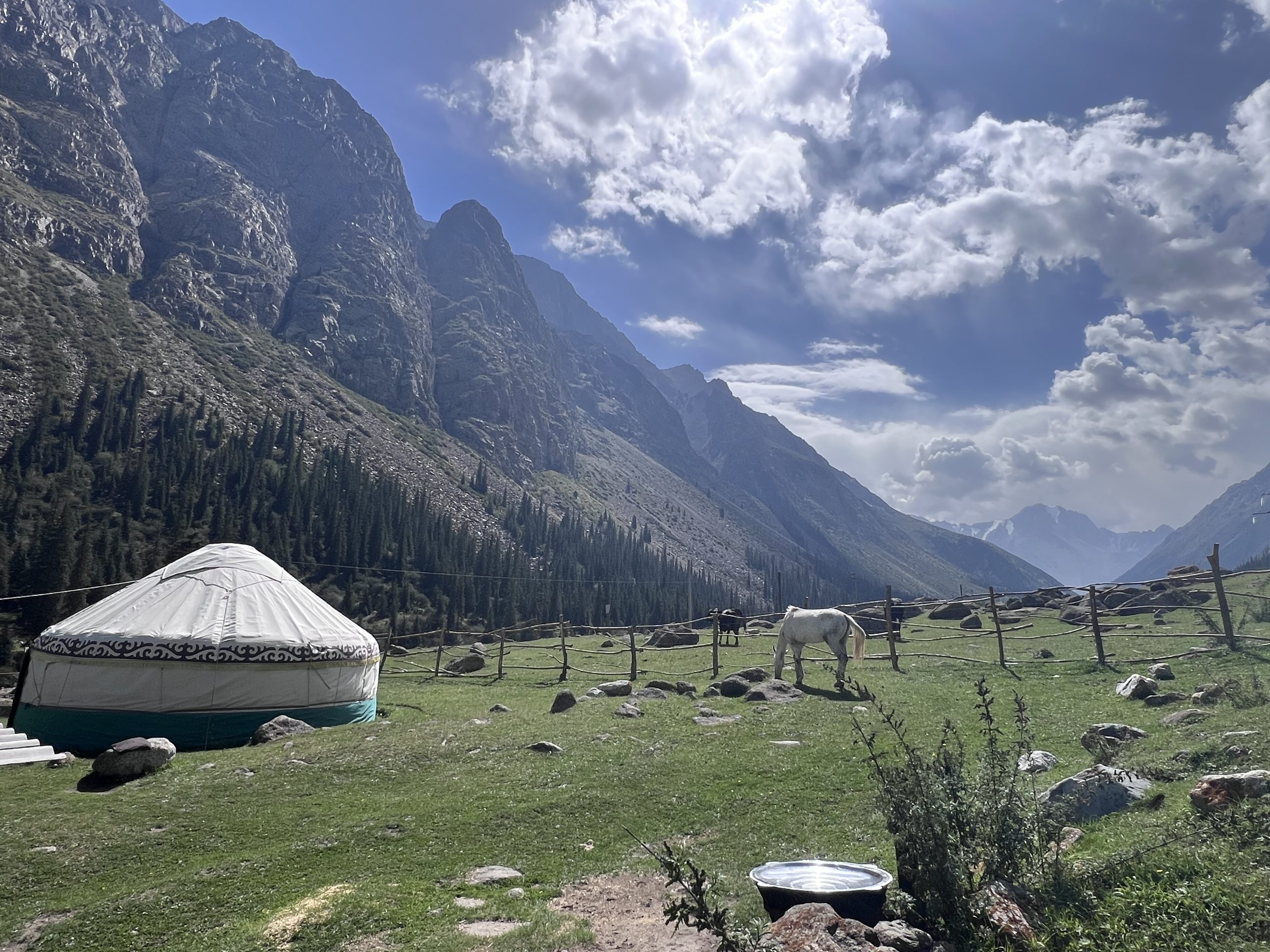
When we put Kyrgyzstan on our travel radar, one big question remained. Was it a suitable destination for us? We’re a couple in our mid-sixties who have never thought about our age in relation to our travels before. But this one felt different. Maybe it was all the epic wild adventures in Kyrgyzstan we were being bombarded with on Instagram ever since we announced our trip. But could we cope with this sort of adventure travel?
We’re fairly active, but I never especially wanted a throw-ourselves-into-the-wilderness-and-sleep-under-the-stars kind of trip. ‘Would you like a four-day horse trek?’ Nope. ‘How about some remote hiking and a stay in a traditional yurt, the bathroom is only just outside the door?’ ‘No thanks.’ ‘What about a 4WD adventure over bone-shaking rough mountain roads?’ Hmmm, I’m not sure…

Kyrgyzstan Adventures for the FIT Traveller
Kyrgyzstan, famous for its dramatic, untouched mountain landscapes and authentic nomadic way of life. We’re not alone in wanting to visit; tourism numbers are booming, driven by those seeking outdoor adventures and by the impact of a certain BBC TV show, Race Across The World.
Kyrgyzstan’s focus is primarily on offering visitors, typically younger than us, access to their great outdoors. We were looking to combine comfort with adventure, and, given that tourism is in its infancy (only 5.31 million visitors in 2025), it remains relatively undiscovered. We decided we needed local experts who understood that when I said I needed a posh pee, I wasn’t looking for a grubby hole in the ground. Now before you call me a complete princess, we’ve travelled a bit. Over the years we’ve backpacked, hitchhiked and explored six continents, usually unaccompanied. We are definitely in the FIT (Free Independent Traveller) category.
This time we decided it was expedient to hire our own driver-guide. Our brief was to make style and comfort part of the plan, but please give us some adventures; we’re not dead yet!
Because yes, I still love an adventure. I just like a decent bed at the end of it!

Why this route
Our trip was 10 days long and centred on the World Nomad Games (WNG), held every two years in Central Asia. Our itinerary had to work around the Games’ fixed date rather than following the usual Kyrgyzstan circuit. We discuss other options and what we might have done differently near the end of this post.
Our journey took us from Bishkek along the southern shore of Issyk-Kul Lake to Bokonbayevo, on to Karakol, and finally around the northern side of the lake to Cholpon-Ata. Along the way we visited some of Kyrgyzstan’s classic sights, including the Silk Road Burana Tower, Fairy Tale Canyon, Jeti-Ögüz and Altyn-Arashan.

What we left out
- Song-Kul Lake, perhaps one of Kyrgyzstan’s top destinations. It seemed like a lot of travel, and the accommodation on offer was rather basic.
- Border-zone areas needing a Kyrgyzstan border permit (the borders with China, Kazakhstan and Tajikistan). The most popular highlight we missed was Kel-Suu Lake, described in a Google search as a ‘high-altitude expedition to see one of the most volatile, jaw-dropping, and isolated geological wonders on the planet’. Oops. You decide whether it’s just too good to miss!
A note on booking late
We booked this trip within three weeks of arrival. With Bishkek full of dignitaries (both President Putin of Russia and President Xi of China were in town with their delegations), most of the best places were already taken. If you book in advance, you will have more choices and better prices, and you should even be able to find yurts with en-suite bathrooms.
Our guide also gave us an interesting local view: Kyrgyz people on holiday look for a guesthouse with an en-suite and all the mod cons, not a yurt. “Yurts are for tourists.”

Getting there, and who to book
Our guide: Farukh, Best Travel
A big shout-out to our guide, Farukh, from Best Travel, whom we can thoroughly recommend.
Finding Best Travel
It was a leap of faith when we came across Farukh through our Kazakhstan tour company, who had recommended a local guide who was unavailable. By the time we were sending off our deposit to what felt like a random stranger, we were wondering how legit it would all be. From what we gathered, tour guides in Kyrgyzstan run their own travel businesses and work independently, but they also have strong connections, recommending one another when they can’t fulfil a booking.
Thank You, Farukh
Thank you, Farukh, for your kind patience, for understanding that we were not up for the high-adventure tour, and for always finding me the best loos around!
How much does a private driver-guide cost?
All guides are negotiable, and we were there at the absolute peak season with the WNG; we paid $ 2,900 USD for two people, including the driver/guide and entry fees. Where some things were optional – ferris wheel, hot springs, etc we paid our own entry; all other National Parks and museums were included.
Because I’m fussy about where I stay, this did not include accommodation, which, again because of the WNG accommodation, was tricky to find and expensive, but I wanted to sort it out – and knowing how particular I was going to be, Best Travel were happy for me to organise.
The total costs for all hotels/guest houses were $1162 USD (had the best hotels not been booked out, I’m guessing we normally would have paid extra for some nights)
Total Cost we independently paid was $4062 USD
A thank you to Audley Travel too
As part of the process, we also reached out to Audley Travel in the UK, which had been highly recommended by friends for its expertise in tailor-made travel. The personal contact regarding our itinerary was helpful, and they were a knowledgeable voice at the end of the phone. Their quote was £7720 (10,220 USD) for two, no flights but including accommodation. In the end, we didn’t have enough time for them to become a serious contender, given how scarce accommodation was. (ensure you have at least 6 weeks prior to your trip) However, seriously, if budgets allow and you want a no-hassle, someone else does all the work, from what we saw they might be worth considering – we have no affiliation with Audley Travel.

Getting to Bishkek
We travelled by private car from Almaty and met our guide at the Kazakhstan border (Korday/Ak-Zhol). The tour finished at the Kegen/Karkara border. Our direct flights from London Heathrow to Almaty were with Air Astana.
Bishkek has direct, nonstop flights to over 30 destinations in 12 countries, but none to North America or Western Europe, so popular routes are via Turkey or the Middle East. Many of us will want to visit more than one of the Stans; the most popular pairing is Kazakhstan and Uzbekistan. If you’re in a neighbouring country, you may choose to arrive by car, or, if you are hardy stock, by train.

Our Itinerary At A Glance
| Day | Base (night) | Highlights |
|---|---|---|
| 1 Arrival Bishkek City Tour | Bishkek: Orion Hotel | Arrival, walking tour, Ala-Too Square, Oak Park, Panfilov Park |
| 2 Bishkek City Tour (cont.) | Bishkek: Novotel | Orion spa, Osh Bazaar, Victory Square, mosque, cathedral |
| 3 Day Trip: Ala-Archa National Park | Bishkek: EcoHouse Glamping by Art Hotel | Ala-Archa National Park, Sky Swing Bridge |
| 4 Road trip to Bokonbayevo | Bokonbayevo Eco Resort Kaiyrma | Burana Tower, flag mural, Konorchek Canyon |
| 5 Bokonbayevo Tour | Bokonbayevo Eco Resort Kaiyrma | Eagle hunting demonstration, Fairy Tale (Skazka) Canyon |
| 6 Road trip to Karakol | Karakol Hills Hotel | Drive via Barskoon Gorge & Jeti-Ögüz |
| 7 Day Trip: Altyn-Arashan | Karakol Hills Hotel | Altyn-Arashan 4WD adventure, Ak-Suu hot springs |
| 8 Karakol Tour | Karakol Hills Hotel | Free day: Dungan Mosque, Holy Trinity Church |
| 9 Road trip to Cholpon-Ata | Cholpon-Ata Zapon Guest House | Drive from Karakol, Echo of the Nomads song festival |
| 10 World Nomad Games | Cholpon-Ata Zapon Guest House | Kyrchyn Gorge, World Nomad Games |
| Departure | Border | Cholpon-Ata to the Kegen/Karkara border, back to Kazakhstan |
Bishkek, Days 1 to 3
We started in Bishkek, the country’s capital and largest city. With a population of around 1.3 million, it feels small enough to get to know reasonably well in a couple of days and is a great starting point to learn about Kyrgyzstan’s history. Where we slept is covered together in the next section.

Day 1: Walking tour
Our first glimpses of Bishkek, on foot, introduced us to a city shaped by Silk Road connections. We had a fair bit of history to learn from Russian expansion, the Soviet era and, more recently, Kyrgyzstan’s independence. All this unfolds (in August) beneath bright blue skies. It’s hot, though not as unbearable as some reports from Uzbekistan, and in the distance there’s still snow on the peaks of the Kyrgyz Ala-Too mountains. It’s a spectacular backdrop.
We soon appreciated that Bishkek has a Soviet-era grid system and, aside from the summer heat, is an extremely walkable city. Having a knowledgeable local guide was especially helpful in bringing the history to life. It wasn’t long before we were introduced to important historical figures, some familiar, like Lenin, and others completely new to us, including Manas, the legendary hero at the heart of Kyrgyz national identity.

Ala-Too Square
A good place to start is Ala-Too Square, Bishkek’s main gathering place, where we find Manas the Magnificent. At one end is the State Historical Museum, which deserves a wander. Traditional Kyrgyz yurts, textiles, and rugs help tell the story of the country’s rich nomadic heritage, making it a useful stop for understanding the traditions that remain so important to Kyrgyz culture.
Time your visit right to catch the Changing of the Honour Guard, which takes place on the hour behind the museum. The soldiers’ initial motionless stance under a massive Kyrgyzstan flag had us transfixed as they came to life with mesmerising, high-stepping precision. Do not miss!

Oak Park
One of our stops was Oak Park (Dubovy Park), officially renamed Chingiz Aitmatov Park. It’s one of Bishkek’s oldest green spaces, and beneath the spreading oak trees there are said to be around 90 sculptures to discover. In a nearby shaded alley we stopped to admire colourful paintings, too. Bishkek’s leafy parks, colourful flower beds and tree-lined avenues soften the city’s Soviet-era concrete.
Would you try a traditional Kyrgyz drink?
Shoro is a fermented drink sold from colourful red, blue and brown barrels at street stalls around the city. Mr Wren gamely gave the wheat-based and yoghurt versions a go. His verdict? It’s like sour milk! They have a distinctive tangy, sometimes salty flavour and are popular in the summer heat. Neither of us was about to swap our usual drinks for them, but at least one of us was up for the challenge!

Panfilov Park
We ended our first tour happy to sit for a while and take a few turns on the Panfilov Park Ferris wheel. Being up high offers a bird’s-eye view of the city, which is bigger than we expected. The surrounding mountains on the horizon hint at what we would explore later in the week. But for now we’ll take the panorama, no hiking boots required!
Tonight we slept at the Orion Hotel (see Bishkek hotels below).

Day 2: Bishkek at a slower pace
This is slow travel, Kyrgyzstan-style, and there was absolutely no point in my mind paying to stay at the rather lovely Orion Hotel without making the most of its facilities. So day two began with a leisurely breakfast (my favourite of our entire time in Kyrgyzstan, as it turned out), followed by some well-earned me-time at the Wellness Centre: indoor pool, jacuzzi, sauna and hammam. It’s my kind of sightseeing!

Osh Bazaar
If you want to see a completely different side of Bishkek, make a beeline for Osh Bazaar. It reminded me of the souks of Marrakesh: noisy, colourful, wonderfully chaotic and full of life. There are mountains of fresh produce (you may find the meat a tad confronting), fragrant spices, dried fruits and freshly baked bread that are soooo photogenic. From traditional horse saddles to baby cots, you could find just about anything here.
Given that we’re new grandparents, we spent a bit of time admiring the wooden cots and learning how babies sleep in Kyrgyzstan: tightly swaddled, with a hole in the cot and a wooden contraption placed to collect the baby’s pee. Like a lot of things in this country, I couldn’t work out whether it was a genius idea or barbaric. Just remember, Wren, you are a guest in a foreign land; mine is not the place to judge! We happily put our haggling skills to the test while picking up a few souvenirs.
Victory Square
Next, for something different, the poignant and striking Second World War memorial that blends Soviet monumental architecture with Kyrgyz nomadic symbolism. At its centre stands a huge yurt-shaped structure formed by three sweeping red granite arches, built in 1985 to mark the 40th anniversary of the end of the war. Beneath its dome, an eternal flame burns in remembrance.
Our guide gave us the human stories behind it, which make you stop, linger and reflect. The bronze statue of a waiting mother, gazing into the distance as she awaits the return of her husband and sons, was particularly heart-wrenching.

Imam Sarakhsi Central Mosque
Next up was a visit to one of the largest mosques in Central Asia: the Turkish Mosque, funded and built by Turks, with its four towering minarets and ornate interiors. Visitors should dress modestly and follow the mosque’s guidance on clothing; inside the door was a cupboard with robes for loan to ensure everyone is well attired. It was a lovely opportunity to learn more about Islam and its place in everyday Kyrgyz life.

The Wedding Palace
We couldn’t help noticing how many wedding venues there were! Our curiosity got the better of us, and we took a peek inside a Wedding Palace. In the 1980s, when Kyrgyzstan was part of the USSR, religious ceremonies were banned; this multi-faith building, constructed in 1987, was still permitted for weddings. If you’re looking for a swanky marble staircase with a red carpet for your wedding photos, plus some bright stained-glass windows, this is your venue. Inside, we found quiet queues of couples clutching their paperwork, a glimpse of local life that makes slow travel so rewarding.

Leafy boulevards and Holy Resurrection Cathedral
Our wanderings continued through Independence Square, past the cultural landmark the Kyrgyz State Circus building and into some of its older, leafier neighbourhoods. You won’t miss Holy Resurrection Cathedral, with its white walls, bright blue roofs, onion-shaped domes and 29.5 m bell tower. It’s Kyrgyzstan’s main Orthodox church and a prominent architectural landmark. Whether you are religious or not, it’s worth a wander; the interior, with its saint relics and beautiful icons, is just as striking, and the outside floral gardens are pretty and peaceful. 📍 497 Jibek Jolu Ave, Bishkek 720033.
What is fascinating about Bishkek is how these different worlds sit alongside one another: Soviet-era boulevards, monumental memorials, bustling bazaars, grand mosques and historic churches. It’s a city that rewards curiosity rather than a hurried tick-list. Bishkek might not be the first city that springs to mind for a Central Asian adventure, but give it a little breathing space, and you’ll discover there’s far more to it than first meets the eye.
Tonight we slept at Novotel City Centre (see Bishkek hotels below).

Day 3: Ala-Archa National Park
It was time to head into the Chunkurchak mountains to visit Ala-Archa National Park, a 40-minute drive from Bishkek. Many tours stay out there, but we felt we had better hotel options in Bishkek, so we made it a day trip.
Ala-Archa was our first proper taste of the dramatic mountain landscapes that would feature throughout our trip. After paying the park entrance fee [250 KGS around $3 USD], we took the modern courtesy bus to Upper Ala-Archa, which is included in the entrance fee. From here you are on your own. With 20 glaciers and 50 mountain summits, the choice is yours; just note some hikes take several days. We took a short hike to the end of the paved road, enjoying the views, the bird calls and the sound of the mountain river alongside us. The road ends at a yurt used for diplomatic meetings. I couldn’t help thinking diplomacy may be a tad easier when you bring your international guests to this peaceful part of the globe.

Hiking options, and what we’d add
It’s a lovely stroll, suitable for most abilities and for pushchairs, but you’ll probably need to go farther into the park to really appreciate its gems. The park website shows all the hiking options, and with hindsight an additional hike to Broken Heart Rock (2.4 km) would have given us a better feel for the park. One of the simplest pleasures was feeding the little birds directly from our hands. Bravo, Ala-Archa, for having options for all ages and abilities.

Cable car and cafés
Back at the cable car station, it seemed appropriate to ride up to the top (400 KGS, around $5 USD per person), at about 2,000 m. It offers views without the mountain climb. There isn’t much up there except a hotel that may not be open, but at ground level you’ll find cafés (we liked Kulikov at the cable car station for fancy coffee with cake, but best of all was the local café Momento, on the right before the cable car), hotels, souvenirs and entertainment such as archery.
Top tips
It’s cooler in the mountains than in Bishkek, so bring layers. There are great toilets at both the cable car station and the park entrance. In tick season (April to September), be aware of tick-borne encephalitis (see the park website: https://alaarchapark.com
Lunch: Supara Chunkurchak
We were taken to this three-star hotel and restaurant in the mountains. It was a pleasant enough pause (it seems to be a popular tour stop) and a place for a traditional Kyrgyz lunch while soaking up more scenery.
Sky Swing Bridge
You know we said we wanted adventure; well, here it was! This too-scary-for-me suspension bridge in the Chunkurchak Gorge was built in 2021, is about 125 m long and sits roughly 80 m above the ground. There’s a loud hailer to shout instructions, like don’t jump, I guess. Mr Wren says there are some nice views from the other side. I’ll take his word for it! You used to be able to go bungy jumping next door, but allegedly the bungy broke, and it has been shut ever since. I feel I made the right call; it was stressful enough watching from solid ground.
Entry is 500 KGS (around $6 USD)

Tonight we slept at Eco Glamping by Art Hotel, on the outskirts of Bishkek. (see Bishkek hotels below).
Bishkek hotels: three nights, three stays
Where we stay is important to me. I typically look for a boutique stay, hoping for something typical of the location, which in Kyrgyzstan would of course be a yurt. To meet our brief, we stayed in a range of hotels and local guest houses. In Bishkek, we deliberately chose a high-end option whilst we could to ease us in, then were forced into more and more local guest house options the more remote we went..
| Orion Hotel | Novotel City Centre | EcoHouse Glamping by Art Hotel | |
|---|---|---|---|
| Night | 1 | 2 | 3 |
| Style | Grand, traditional, luxury | Modern, reliable, functional | Quirky, nature, outskirts |
| Best for | Room, Spa and breakfast | Central location, no fuss | A “different” stay |
Orion Hotel: a little luxury between adventures
I really wanted to stay at the Orion, as it’s probably considered Bishkek’s finest hotel, and I wanted to know what “fine” meant in Kyrgyzstan. We found a surprisingly grand, well-sized room with everything I love in a good hotel stay.
Despite being built in 2019, it feels like a historical stay. There are 84 rooms and suites; the traditional interiors might not appeal to everyone, but our spacious rooms, thoughtful touches, excellent wellness facilities (swimming pool, jacuzzi, steam room, and sauna), and a lovely breakfast are a big drawcard. I found plenty of quality to admire: a coffee machine (that’s the Aussie in me), crystal glasses, a humungous comfy bed with gorgeous linen, plush carpet and curtains, fancy toiletries, and toilet paper that made me smile, with the end of the roll sealed with a Hotel Orion sticker and the words ‘beyond ordinary’. I even took a video of myself oohing and aahing over the stationery set. Who needs writing paper these days? No one, but it’s a lovely blast from the past.
Dinner at Symphony Restaurant. We were looking forward to dinner at the hotel’s highly rated Symphony Restaurant. The food was lovely, and we couldn’t fault the culinary offerings, but the lack of people, and therefore atmosphere, left us wondering where everyone else had disappeared to. Breakfast, on the other hand, was brilliant: a generous buffet with a huge choice of local and international dishes, and a much livelier affair.
More at: https://orionbishkek.com/

Novotel Bishkek City Centre
Opened in 2021, the hotel has 160 rooms described as sleek, spotless, and comfortable, with upper floors offering panoramic views of the city and snow-capped mountains. Cheaper, as you would expect, and more modern than Orion: a definite step down, so a coffee sachet rather than a coffee machine. However, the Novotel does what it says on the packet: reliable, modern, functional. Very comfortable bed; the varied morning breakfast buffet was good. We liked the location.
It does focus on tour groups, and I would not be at all upset if this were where my tour company said I was staying!
More at: https://all.accor.com/hotel
EcoHouse Glamping by Art Hotel
If you’re into unusual stays, factor this into your Bishkek itinerary. From the friendly welcome and quirky arrival transfer for us and our suitcases (in the back of an open-air motorcycle truck) to the thoughtfully designed accommodation, the wonderful views and the delicious balcony breakfast, there was plenty to make it memorable. Our space-age-looking yurt had all mod cons, including air conditioning and an ensuite bathroom. Each had its own deck with plenty of seating; the swinging egg chair was the best!
It’s a brilliant option for travellers who want something a little different without giving up the comforts that make a stay enjoyable. You get the feeling of escaping into nature, with Bishkek spread out below and the mountains beyond, without disappearing into the wilderness. We loved our stay; it was worth the detour to the outskirts. This stay is remote, with no on-site restaurant. Plenty of people say it’s not easy for the independent traveller to find, but our guide had no trouble getting us there.
More at: https://ecohouse.kg/en

Where we ate, drank and shopped, and what was recommended to us in Bishkek
- COFFEE: Sky Aroma & Giraffe for a coffee close to Orion Hotel
- BARS: The No Name Bar (92 Bokonbayev St): close to the Orion Hotel, was a great find. We braved the rain in search of local nightlife and found this buzzing, stylish spot with fabulous cocktails, exactly the atmosphere and finesse we’d hoped for in Bishkek.
- Vinoteka: on my list for its wine, cheese and vegetable options.
- RESTAURANT: Pechki Lavochi, a family restaurant that was recommended to me.
- SPAS: Both Orion Hotel and Novotel have their own Spa. Mystic Spa was on my list.
- SHOPPING: Check out Tumar for traditional Kyrgyz slippers.
Top tip: If a cocktail, beer or glass of wine matters to you, be aware that many restaurants are Muslim-owned and don’t serve alcohol.
Issyk-Kul, Days 4 to 9
Issyk-Kul Lake: the big picture
You’ve got thousands of kilometres to reach the sea from Kyrgyzstan, which is a big reason why this landlocked country, one of the farthest from any ocean in the world, makes such a big deal of Issyk-Kul. What it lacks in seascapes, it makes up for with vast alpine lakes. When you spot the deep blues of Issyk-Kul, you’d be forgiven for thinking you’d reached the sea. It’s about 180 km long, more than 600 m deep, and has real sandy beaches.
It is the second-largest mountain lake in the world (after Lake Titicaca), at an altitude of 1,606 m. This saline alpine lake is set in the Tian Shan mountains, whose peaks reach over 4,000 m.

Day 4: Bishkek to Bokonbayevo via Burana Tower
Today was our first extensive road trip, about five hours in the car, heading east along the southern shore of Issyk-Kul. A road trip in Kyrgyzstan is like sitting in a gold-class movie seat: outside, the ever-changing landscapes at times feel like one of those super-duper screen savers your PC comes loaded with. Car conversations were so varied and interesting. Over our 10 days, we covered everything from everyday life to snippets of history. This was already proving to be my kind of travel.
Burana Tower (UNESCO World Heritage Site)
The ancient city of Burana: the Silk Road settlement and what remains of it.
Our first major stop, 90 minutes from Bishkek, was one of Kyrgyzstan’s most important Silk Road sites. Once upon a time, in these windswept lands, stood the ancient settlement of Burana (Balasagun), an important trading centre at the crossroads between East and West. You’ll probably have to channel your inner Marco Polo to picture it in its heyday. Today little remains on the treeless grassy plain except a brick minaret, which dates back to the 11th century, surrounded by grassy mounds, earthworks and parts of foundations marking where the citadel once stood.
Climbing the tower: the rebuilt minaret and the no-handrail staircase.
The tower was originally twice as tall; an earthquake destroyed the top in the 15th century, and it was reconstructed in the 1970s. For those up for the adventure, you can climb it for unobstructed views of the Tian Shan, but you’ll need your hands to climb the worn steps, like a ladder, in the dark. There is no handrail on the spiral staircase, and only one person can go up or down at a time, so queues may form.
The museum and the balbals: the air-conditioned museum and the stone grave markers
It’s a hot, exposed site, so the small air-conditioned museum offers welcome relief and a glimpse of Silk Road artefacts and carved petroglyphs. The outdoor display of balbals (stone grave markers), ancient and rare carved figures from the 6-10th century, is a reminder that Kyrgyzstan’s story isn’t just spectacular mountains and nomadic traditions; the Silk Road has left a fascinating legacy, too.
Top tips: Bring a head torch for the tower climb. I might have looked naff, but I appreciated my umbrella for the shade! The best toilets are in the car park, not inside the complex. Entry was 220 som for foreigners at the time of our visit.

Konorchek Canyon
The turn for Konorchek Canyon is a sudden off-road turn into a nondescript parking lot, the sort of place in my country where I’d be preparing not to leave any bags in sight. No such worries here! The 8 km return hike into Konorchek Canyon was one of my favourite hikes. The landscape, formed by the erosion of Paleogene sand and clay, has tall, ochre- and rust-coloured pillars and a maze-like network of exposed rock walls.
For me it felt challenging but doable on a fine-weather day (I was glad it wasn’t slippery). There are five obstacles to traverse through narrow, winding gullies, some with the occasional help of ropes. I was grateful for my walking pole and the strong arm of our guide. The walk into the Boom Gorge took about 1 hour 15 minutes. From there you can continue further, and we saw a couple of brave souls who had climbed up for higher views of the striking red-sandstone gorge.
This was not the first time I thought that having a guide is invaluable. They briefed us to be aware of our surroundings, particularly falling rocks. Nothing in this country comes with health and safety warnings, so be careful, y’all!
Top tip: Wear proper hiking shoes, for comfort and safety.

Our base: Bokonbayevo
Bokonbayevo is best known as an attractive lakeside holiday destination for locals (most foreigners typically hang out in Cholpon-Ata). What brings international travellers is eagle hunting and Fairy Tale Canyon. It has probably outgrown its village feel, and all the roads were under repair during our visit. We loved that there are no traffic cones here, just a line of rocks in the road to guide you along the best path! New road connections will surely boost growth in the region. For now, it’s a reasonable base for avoiding endless unpacking and repacking.
There is not much to see; an hour will suffice. We stopped at the Soviet-era war monument, a memorial to soldiers who died in the Great Patriotic War (WWII), and an unexpected highlight was the art gallery behind it. We were shown around by the gallery owner, a painter, who was keen to show us his students’ work, inspired by petroglyphs.

Where we stayed (2 nights): Eco Resort Kaiyrma.
We booked late, and our stay was simple and pretty basic, but good enough for two nights. It’s popular with adventure tour groups and highly rated by those heading off to or returning from the wilds. I’m not sure I’d give it such glowing recommendations, but we were happy to support a local guesthouse that offered an en-suite bathroom, and we enjoyed the views, the room’s style, and the local charm.

Day 5: Eagle hunting and Fairy Tale (Skazka) Canyon
Eagle hunting demonstration.
Eagle hunting is a traditional nomad practice in which hunters, called berkutchi, train golden eagles to hunt. Demonstrations are offered to visitors in places like Bokonbaevo. Ours was a private session arranged by our guide, costing 5,000 som (about 57 USD) and lasting just under an hour. Whether to watch one is a personal ethical call. We went in August 2026, and we’re glad we did, but ask lots of questions first. You can read more in our earlier post on eagle hunting.
The connection between people, horses, eagles and the landscape became an increasingly important theme of our trip. Little did we know how much of it we were about to see at the World Nomad Games.

Fairy Tale (Skazka) Canyons.
The name is wonderfully appropriate. The landscape is filled with unusual red and ochre rock formations, sculpted by wind and weather into shapes that seem almost otherworldly. This is another one of those places that you can stay as long as you want to hike around at varying levels of difficulty. Mr Wren and our guide set off to climb a narrow hilly path whilst I stayed at ground level, browsing the handicraft store and have regretted ever since not buying those slippers
Afterwards we headed to the next-door Royal Gate restaurant and Yurt campsite for a snack. They have 40 Yurts here; they cost 7,000 KGS (80 USD). The bedrooms are small and a bit crammed together.
Jeti-Ögüz
Later that day we took in another of Kyrgyzstan’s famous red sandstone sites, Jeti-Ögüz, or Seven Bulls, so called because the seven massive cliffs standing next door to each other look like, well, you guessed it, seven bulls lying down… This time, our guide managed to drive our 4WD up a short, bumpy off-road track to the viewing point at the top.
The poor sods on the coach tour had to walk up or take a horse up the dusty road, so we were feeling quite smug to get up there. Not that this let us off the hook with the keen horseback kids hassling us to take a ride with them. I’m not sure about you, but I have already mentioned that I have not been on a horse for donkey’s years, and it was hard enough mounting one for a static Eagle photo, but I’m definitely not about to make my second attempt be up the top of a mountain with sheer drops all around!
However, happy days, there is what has to be one of the best spots for a nice-looking coffee shop up there, from which we can admire the towering crimson rock cliffs, and learn about some of the dramatic local legends from our tour guide.

The Broken Heart
One such legend was the Broken Heart rock at the entrance of the gorge; this split red rock formation looks like a broken heart cleaved in two. According to local legend, two rival khans fought over a woman, and her heartbroken blood stained the rocks red. Now I’m wondering why she was the heartbroken one, as surely one of the Khans lost out – if you get there, maybe you could pay more attention than me and let me know!
This area is also popular for its easy access to alpine hiking trails, so you can plan to spend a lot longer here than the couple of hours we did.
Tonight we slept at Eco Resort Kaiyrma again.
Day 6: Bokonbayevo to Karakol
Barskoon Gorge
The drive in
We continued around Issyk-Kul towards Karakol, stopping at scenic viewpoints, then took a mega dusty, construction-filled road to Barskoon Gorge. Perhaps because it felt like an effort to get there, along dramatic switchbacks on the road toward the Kumtor gold mine, the scenery was, quite frankly, ridiculous. Every time I thought we’d seen the best mountain view of the day, another one appeared.

Waterfalls, spruce forest and yurts
Barskoon Gorge, off the southern shore of Lake Issyk-Kul, was my absolute favourite. Just as I’d hoped for the Kyrgyz landscape, we found two towering alpine waterfalls amid the dense Tian Shan spruce forests. This was once a historic Silk Road corridor and today remains the gateway to high-altitude mountain plateaus. You’ll find a few remote yurts to rent from the families who have made this area their home and livelihood.
Maybe because it was harder to get there (another example of where we were happy to have our driver know exactly where to go), we had the place practically to ourselves.
We walked up to two spectacular waterfalls: the first, called the Cup of Manas, took an hour to reach, and then we walked across the mountain to the second, called Tears of a Snow Leopard. It was a bracing climb, definitely a bit of exercise for us. Although our guide, used to harder climbs, calls it a walk! For the Tears of a Snow Leopard, the walk involves clambering over rocks. The paths are well used; I was pleased to have my pole and glad it was dry, and glad I wasn’t attempting this during the rains.
The waterfalls were lovely, but the yurts and the valley landscape were my ideal picture-perfect Krygsz photo spots!

The Yuri Gagarin monuments
We also spotted the unexpected roadside monuments honouring Yuri Gagarin, the Soviet cosmonaut and first human in space; they don’t feel especially random in this landscape. Apparently Gagarin holidayed at a nearby military sanatorium on Lake Issyk-Kul after his historic 1961 spaceflight!

Toilets and entry
Toilets: We were warned the facilities would be of the most basic kind here, but happy days, we spotted one toilet block and paid a few som to use it.
Entry: Free! This is an absolute bargain. It isn’t within a national park with entrance fees; it’s an open natural space with no charge.
Pokrovka (Kyzyl-Suu)
We stopped in Pokrovka, the sort of Agricultural village where sheep are grazing beside the pavements. It was not the sort of place we expected to find a memorable restaurant for lunch, but we did. It was called Чүйгүн (Chugun / Chuigun (written in Kyrgyz), meaning “enjoyable” or “delicious”- and it was. Here you will find Kyrgyz and Uyghur cuisine, grilled meats, and signature shashlik. You can find more @chyigyn.resto.bar

Where we stayed in Karakol: Hills Hotel
Karakol would be our base for three nights, which was very welcome. By now we had clocked up plenty of kilometres, and I was rather pleased not to be changing hotels every night.
We really enjoyed our stay in Karakol. The hotel is a ski lodge-meets-art hotel. We had an upgraded comfort room. The wooden swish design has a great vibe with its exposed stone, terracotta tiles, and traditional textiles; our room was large and comfortable. It’s a nice hotel in terms of both cleanliness and comfort – there was a bad smell upon arrival coming from the water pipes, but it seemed to disappear afterwards (or we got used to it!!)
The staff were on the ball and helpful. The Wi-Fi was good. With a car, the location is convenient for discovering Karakol and its surroundings. Breakfast was fine rather than extraordinary, but plenty good enough for us to feast upon before a day exploring. Given the hotel is a bit in the middle of nowhere, we were pleasantly surprised. We would book again.
Website: There is no official standalone website for this hotel; you can view and book through major platforms

Day 7: Altyn-Arashan
One of the big, memorable places in Kyrgyzstan, not that I’d know, as I bailed on the trip. The excursion involves heading into the mountains in an old Soviet 4WD, through increasingly rugged terrain. The spectacular alpine valley scenery was extraordinary. The journey, however… It wasn’t the bumpy mountain roads that defeated me. It was the fumes inside the vehicle, which I couldn’t cope with, so I abandoned the tour. Mr Wren continues the story in Altyn-Arashan: Are We Too Old for Wild Adventures?
I didn’t make it all the way, but I’m glad I listened to my body instead of forcing myself to stick to the itinerary. Adventure is wonderful. Knowing when to say “not today” is also a skill.

Ak-Suu Hot Springs
The local hot springs seemed like a good idea for relaxing an all-shook-up body. This thermal spa is a 25-minute drive from Karakol, with outdoor pools of varying temperatures fed by natural thermal waters and a river dip for those who want a polar plunge. There are changing rooms and showers. It was a frenetic experience, extremely busy when we were there, but highly local. If you love your Hot Springs, then it’s worth it for the sheer experience.

Day 8: A lazy day in Karakol
After our mountain adventures, we had a free day. Mr Wren had food poisoning, either from something he ate in a remote mountain gorge or the fumes catching up to him! While he stayed close to the bathroom, our relaxed itinerary let me explore Karakol with our guide.
One of the things I’ve learned from travelling extensively is that a good itinerary isn’t necessarily one where every hour is filled. Sometimes you need a day to wander. Let’s be honest, there’s not much to rush between in Karakol anyway. The city is best known as a base for exploring the surrounding countryside and, in winter, as a popular, budget-friendly ski area widely considered the best in Kyrgyzstan and Central Asia. Even so, I enjoyed the sights.

One of the city’s main sights, the Karakol Historical Museum, was closed for renovations during our visit. On Sundays, visit the vibrant animal market where local farmers trade horses, sheep, cows, and yaks.
Here is what we found to see, do and love:
Dungan Mosque.
Built in 1910 by the local Dungan (Chinese Muslim) community, this vibrantly painted wooden mosque was constructed completely without metal nails, in a traditional Chinese architectural style. It wasn’t open to enter, but a pleasant enough stroll around the exterior and gardens

Holy Trinity Church
Worth a stop for the contrast alone. This wooden Russian Orthodox church, built in the 1890s, is a reminder that Karakol began as a Russian garrison town, and it sits happily alongside the Dungan Mosque a short distance away. Its onion domes and carved timber give the town a very different look from the surrounding mountains, and the peaceful grounds make a calm break between sights. It’s an easy, flat visit that suits all ages and reveals another layer of the region’s rich cultural story.
Buguu Bazaar (Central Market)
We took a wander around the local market, which was one of those hot assaults on your senses with lots of noise and smells that you’ll either love or hate.

Przhevalsky Museum
Probably for want of nothing else to do, we took a drive out to the Nikolai Przhevalsky Museum, on the city outskirts. This museum is dedicated to a famous 19th-century Russian geographer and naturalist who led major expeditions across Central Asia, Mongolia, China, and Tibet. He died in the city from typhoid as he was preparing to leave for his 5th expedition to Tibet. The city was renamed Przhevalsk twice before returning to its original name in 1991, so he might be unknown to us, but he was an important figure, and the museum (again, empty; I was virtually the only one there) was a nice enough place to wander.
There are a couple of buildings to enter (there isn’t much in English), but you can just about work out the gist from the 2,000 exhibits, including his expedition maps, scientific instruments, personal belongings, and botanical specimens.
Wandering the grounds, you’ll find Przhevalsky’s tomb and a famous 1893 monument topped with a bronze eagle holding a map of Central Asia

Day 9: Karakol to Cholpon-Ata
We left Karakol and drove about 2 hours 20 minutes to Cholpon-Ata. This wasn’t just another travel day. We were now heading firmly towards the reason our itinerary was structured differently from many classic Kyrgyzstan tours: the World Nomad Games.
Where we stayed in Cholpon-Ata: Zapon Guest House (2 Nights)
We were very grateful to find anywhere that would take us during the World Nomad Games. The Zapon Guest House was well-rated, and we were lucky to find the last room for our dates at this simple, family-run place. The room was basic with comfortable beds and an en-suite. Their breakfasts were homemade in front of your very eyes, and the staff were wonderful. If you are after a budget stay, this is worth checking out.
The World Nomad Games, Days 9 and 10, and the border
That evening we attended the opening of the International Ethno-Song Festival, “Echo of the Nomads.” After days exploring the landscape, this was our chance to see another side of Kyrgyzstan: its music, traditions, costumes and cultural heritage. It was becoming clear that the Games would be much more than a sporting event. You can read more in our World Nomad Games post.

Day 10: Kyrchyn Gorge and the Games
Our final full day took us to Kyrchyn Gorge, where we attended events at the Ethnocultural Village “Universe of Nomads.” And wow. Nothing really prepares you for the sight of hundreds of yurts spread across the mountainside. There were traditional performances, handicrafts, cultural exhibitions and competitions, along with the extraordinary spectacle of people arriving from across Kyrgyzstan and around the world.
This was the point where so many parts of our trip came together: the wild horses we’d seen on the roadside, the traditional costumes, the eagle hunting, the nomadic heritage, the mountains, the yurts, the music. Suddenly they weren’t separate tourist experiences. They were part of a living culture.

Departure day: to the Kazakhstan border
The drive over the hills from Cholpon-Ata to the Kegen/Karkara border was one of the best road trips of the tour. Maybe because we were sad to be at the end of our holiday, but this route seemed to show us the best of Kyrgyzstan. We passed endless sheep, cows, horses and donkeys on the roads, being brought down from their high summer pastures. A wonderful sight.
Practical tips
Transport
For over-60s and those seeking comfort alongside adventure, I highly recommend a private driver in an air-conditioned 4×4 SUV. The roads around the lake are generally good, but detours into scenic gorges need sturdy vehicles to avoid a bumpy, tiring ride. We met people who had hired cars, but the distances were long, and we would never have learned so much about the country, its history, and its people without our guide.

Getting around without a guide
We met plenty who were travelling without the luxury of a guide and a driver. Here are some of their tips:
If arriving in Bishkek from Almaty, take Bus 34, bookable via 12Go; allow several hours for the border crossing.
A taxi from Bishkek to Cholpon-Ata costs $75 USD.
For local travel in Bishkek, download the Yandex Go App; it doesn’t work everywhere, though
As we found when we got stuck at the World Nomad Games, hitchhiking is common in Kyrgyzstan, and shared vans or taxis are an option where Yandex isn’t available.

Phone and data
We used a GigSky eSIM, which we’d already been using in Kazakhstan and was easy to extend to Kyrgyzstan. You need a local eSIM to use the local ride-share apps and receive activation codes. Those who did the four-day horseback trek around Song-Kul reported that, most of the time, there was no phone service.
Money
We used a mixture of USD and Kyrgyz (KGS) Som. The US Dollars we brought with us to pay our tour guide, which meant travelling with rather a nervous amount of cash. We also found additional ATMs with our guide’s help to withdraw KGS in cash from our WISE accounts.

Weather and gear
August in Bishkek is hot; the mountains are cooler, so bring layers. Bring proper hiking shoes, a walking pole, a head torch for Burana Tower and an umbrella for shade.
When is the best time to visit?
Low Season is October to March
High Season is June, July, and August, the busiest months.
At other times of the year, there are fewer tourists (almost zero, according to our guide). Our timing was fixed with the WNG, but otherwise we would have looked at the end of spring, April/May and September as interesting months to visit
Could we cope? A quick difficulty guide
| Activity | Difficulty | Our verdict |
|---|---|---|
| Ala-Archa paved-road stroll | Easy | Suitable for all ages and pushchairs |
| Burana Tower climb | Moderate | Hands needed, dark, no handrail |
| Konorchek Canyon (8 km return) | Moderate | Five obstacles, some ropes; walking pole and guide helped |
| Barskoon Gorge Waterfalls | Easy/Moderate | Uphill but manageable |
| Sky Swing Bridge | Scary | Mr Wren yes, me no |
| Altyn-Arashan 4WD | Tough | Fumes defeated me; consider a newer vehicle |
How we could have done it differently
Kyrgyzstan offers several routes, and if we hadn’t been travelling for the World Nomad Games, we could have arranged our trip quite differently.
The classic route. A more traditional circuit could have taken us from Bishkek to Issyk-Kul, Karakol, across the southern shore and into the mountains before returning towards Bishkek. That would have made it easier to include Song-Kul, one of Kyrgyzstan’s most iconic destinations, with its high-altitude lake, yurts and horses (though do check the accommodation to see if that’s what you’re after). With a few extra days we could also have gone farther, to Naryn and Tash Rabat, or spent more time around Karakol.
The VIP train. You can take a special VIP train between Bishkek and Balykchy near to Cholpon-Ata, making the journey itself part of the experience. The trade-off is that the train doesn’t naturally include Burana Tower, which is on the road route. Having visited Burana, I wouldn’t have wanted to miss it. So it’s essentially a choice:
- By road: Bishkek, Burana Tower, Issyk-Kul.
- By VIP train: Bishkek to Balykchy, then taxi to Cholpon-Ata, with the train as an experience in its own right.
With enough time, you could of course visit Burana separately before taking the train.
What I’d add with more time. Song-Kul would be top of my list, and I’d have liked more time around Karakol and the eastern side of Issyk-Kul. But adding destinations isn’t always the same as adding enjoyment. Kyrgyzstan involves long stretches on the road, so I’d rather see a little less and have time to appreciate it than spend the whole trip chasing the next destination.
Would we do it this way again?
A broad slice of Kyrgyzstan
For a trip centred around the World Nomad Games, yes. We saw a surprisingly broad slice of Kyrgyzstan in ten days: its capital, Silk Road history, huge Issyk-Kul, spectacular canyons, alpine valleys, traditional culture and, finally, the extraordinary Games.
Finding the sweet spot between adventure and comfort
Was it the complete Kyrgyzstan experience? No. But that wasn’t really the point. Our itinerary was about finding the sweet spot between adventure and comfort, and we felt we achieved it. We wanted the mountains without pretending we were hardcore trekkers. For us, we were keen to experience nomadic culture without necessarily sleeping in a yurt every night. We wanted to explore, but also to have enough breathing space to enjoy where we were.
So, could we cope?
So, back to where we started: could we cope? Yes, with a guide, a sturdy air-conditioned car, a decent bed at the end of most days, and the freedom to say “not today”. Perhaps the biggest lesson is that you don’t have to do every adventure just because it’s there. Choose the bits that make your heart sing, give the bits that don’t appeal a miss, and you can still have one heck of an adventure.
Over to you
Thank you for reading all the way to the end. We hope we’ve shown that whilst Kyrgyzstan is primarily aimed at the backpacker market, older travellers who are keen not to rough it can find a degree of comfort here.
Would Kyrgyzstan be on your travel radar?

Writer Bio: Jenny Littlewood is the writer and photographer behind Little Wandering Wren, an award-winning travel blog. She has lived in Singapore, Hong Kong and Thailand, and has explored six continents as a backpacker, hitchhiker and now a comfort-loving independent traveller in her mid-sixties. Jenny writes about memorable stays and worldwide wanders, with a soft spot for comfort-meets-adventure travel for the over-50s and young at heart. She visited Kyrgyzstan and the World Nomad Games in August 2026 with her husband, Mr Wren. This guide is based on their own 10-day trip with a private driver-guide. Follow her adventures on Instagram @littlewanderingwren.
Published November 2026.
You might also enjoy: