By happy coincidence, we were to be in Central Asia when we discovered that the World Nomad Games were taking place in Kyrgyzstan. What do you mean you’ve never heard of the Nomad Games? Well, until recently, neither had we!
But the more we read, the more intrigued we became. Suddenly, our thoughtfully planned travels through Kazakhstan and Kyrgyzstan had acquired an entirely new purpose. Whatever else we did, wherever we went, we needed to be in a remote mountain gorge in northern Kyrgyzstan for the Games, held from 31 August to 6 September 2026.
What followed became one of our most memorable travel experiences… You see, you don’t simply attend the World Nomad Games. You join a mass of humanity in a far-off land, all of whom have their own extraordinary journey just to get there. And what happens next? Well… wild, wonderful and utterly unforgettable moments that you could hardly make up if you tried.
Read on as we attempt to share with you through our words and photos some of the bonkers excitement of the 6th World Nomad Games.

What are the World Nomad Games?
The World Nomad Games are an international celebration of traditional sports, culture, and the heritage of nomadic peoples. At their heart is a simple but powerful idea: promoting friendship, unity and mutual respect between people and cultures. In a world currently marked by wars, division and far too many reasons to focus on what separates us, bringing people together feels more important than ever.
Hallelujah — we all know the world needs more of this right now!
34United in strength, united in spirit

Such is the motto of the 2026 games. The event began in 2014 as the largest assembly of descendants of nomadic societies from the Eurasian steppes. Since this date, every two years a growing movement gathers to demonstrate prowess in a range of nomadic games. This includes games of strength, skill, and strategy, and perhaps the one that delights the crowds most: those on horseback.
33What are the events?

To us uninitiated, there are sports we recognise, such as wrestling, tug-of-war, and archery. We find events that we really should see more of, like the wildly beautiful horseback archery, where competitors are assigned a random horse and canter, firing off as many arrows as they can shoot at the target within 20 seconds. There are the thoughtful, intensely intellectual mind games, and finally, there are the downright extraordinary. Perhaps the most famous being Kok-Boru, a spectacular horseback team game that has to be seen to be believed.
32Where are they held?
This is the third time that Cholpon-Ata has hosted the World Nomad Games. This small resort town in Kyrgyzstan is a popular, booming tourist destination on the northern shore of the famous Lake Issyk-Kul. The first games were held here in September 2014, with a mere 583 athletes from 19 countries competing in 10 sports.
31Who competes?

In 2026, this was no small regional event. The growth of the World Nomad Games is remarkable, with more than 3,000 athletes from over 100 countries coming together to compete, celebrate their cultures and share traditions. Among them, we were able to cheer on teams from Australia, Great Britain and the United States.
30Access for all
And perhaps you might well ask: what does a Brit know about horseback archery? Or even how are the teams selected? This is one of the things I loved most about the World Nomad Games: everyone seemed welcome – whether you had a long heritage in the sport, or you’d just decided to have a crack at something new in a far-off land – yes, really!
One of the most remarkable aspects of the World Nomad Games was that, apart from the opening and closing ceremonies and the Ethno song events at the Cholpon-Ata Hippodrome, which had a small entrance fee of 500 Som ($5 USD), all other events were free.
Let the Games Begin
29Bishkek Opening Ceremony

The Opening Ceremony was wildly impressive: the music and choreography by performers and animals were next-level. They even managed to make the competitors’ entrance parade interesting for all with the most spectacular graphics. One comment summed it up:
“Better than the Olympics Opening Ceremony.”
Behind the scenes, though, things were already less polished. Cancelled hotel rooms, elusive Games minibuses and long waits were just the beginning. In the Games logistical defence, the timing was a little crackers. The Games coincided with a major leaders’ meeting and Independence Day, bringing road closures, chaotic transport and eye-watering hotel prices.
Locals warned us Bishkek would be a “nightmare”, with one wonderfully simple piece of advice: “Be out of town.” Which is exactly what we did and watched the event on YouTube Live.
The stage was spectacular. Getting to it was another story entirely.
28Rukh Ordo; Music, Stories & Living Culture

On the first day, while thousands of people were making the 3–4-hour journey from Bishkek to Cholpon Ata, we were already there, smugly. As the World Nomad Games gradually came to life around us, we set off to explore and see what we could find.
Our first stop was the Rukh Ordo Cultural Centre, where the atmosphere was one of excited anticipation rather than full-blown Games fever. Or maybe it was more like, “Crickey, will it be ready in time?” There was grass being mowed, strimmers buzzing, stages being constructed, dance routines being rehearsed and stalls springing up selling all manner of traditional nomadic attire. It was clear that something big was about to happen.
Rukh Ordo was preparing to host part of the International Festival of Traditional Music “Day of the Epos: The Art of Storytelling”. Not that we got to see much, but it did give us an early glimpse of just how diverse the programme surrounding the World Nomad Games was going to be. This wasn’t simply a sporting event; music, storytelling, culture, history and traditional arts were all part of the celebration.
27A Place of Peace and Pilgrimage

Rukh Ordo sits right beside Lake Issyk-Kul, one of Kyrgyzstan’s major tourism attractions, and this was actually the closest we got to the lake during our time in Cholpon-Ata. At around 182 kilometres long, Issyk-Kul is the world’s second-largest alpine lake after Lake Titicaca in South America, which helps explain its appeal.
Interestingly, the lake is completely incidental to the World Nomad Games. It provided the spectacular setting and plenty of accommodation, but the Games were happening elsewhere. Nomad culture celebrates the heritage of steppe and mountain nomads who traditionally lived on vast, landlocked grasslands rather than maritime or coastal environments – water, what water?
Rukh Ordo itself was perhaps the more fascinating discovery. Rather than an exciting part of the World Nomad Games. The cultural complex is home to five chapels representing the world’s major religions: Christianity (including Catholic and Orthodox traditions), Islam, Buddhism, and Judaism.
As such, there was something wonderfully fitting about beginning our World Nomad Games experience here. An event whose very purpose is to bring people and cultures together, starting in a place that celebrates different faiths and traditions, felt almost symbolic.
26Meeting the Women of Kyrgyzstan

One minute I’m being photo-bombed by Kyrgyz women, the next we are cosying up as best friends!
It also seemed like a place of pilgrimage, or at least we benefited from it being a location that those Kyrgyz on holiday wanted to visit, with many visitors wandering around in their beautiful national clothing. There was an intrinsic interest in those who looked like they came from foreign lands – us!
The beauty of the World Nomad Games was how easy it was to start random conversations with strangers even when our ability to communicate was limited. My Russian and Kyrgyz remain firmly in the “smile, wave and hope for the best” category, but somehow, there always seemed to be at least one person in the group who could work out that I was from Australia!
And so, without much shared language, there were smiles, gestures, pointing, photographs and plenty of laughter. It was a lovely reminder that you don’t always need words to connect with people. I was beginning to feel a tad underdressed though!
Games of Strategy
Next up, we are determined to see some games in action and arrive at the Eurasian Hotel, reportedly one of the VIP hotels in the region and, more importantly, home to the ‘Brain Olympics’.
How hard could it be to find the event? Quite hard, as it turned out.
Whilst there were World Nomad Games flags at the entrance gates, nobody had thought to brief the security guards that the Brain Olympics were actually happening. Our driver dropped us off, saying, “I’ll go and park the car; I think it’s that way…” Well…. we deployed all our combined nous, logic and detective skills trying to work out where on earth we were supposed to be going. After trekking at least 3,000 steps, and having inadvertently enjoyed a full guided tour of every dusty, dug-up road in the 20-hectare hotel complex (I’m like, this can’t be it, surely they would have repaired the roads for their World Nomad Games guests?!) we were beginning to wonder whether the real Brain Olympics was simply finding the entrance.
Thankfully, two young World Nomad Games volunteers came to our rescue. They spoke English, knew exactly where we needed to go, and scooped us up with plenty of glee to practise their English with two dim, lost tourists. We would have loved to thank them properly and, naturally, take a photo, but they insisted there were to be no photographs of them doing what was essentially one of the best jobs at the Games, and instead insisted that they took photos of us. Fair enough. Secret Brain Olympic operatives, apparently.

25Toguz Korgool
Eventually, we were delivered to the hall where the competitors were playing Toguz Korgool, a traditional Central Asian strategy game played on a wooden board with little blue balls. To our untrained eyes, the balls looked remarkably like blueberries. It was all impressively intense. Toguz Korgool (Nine Pebbles) is one of the most complex strategic board games in the world; Kyrgyz and Kazakh masters secured the top seeds, demonstrating their mathematical precision.
We were escorted to the edge of the playing arena, with a multitude of desks labelled with their respective countries. There was a hush in the air, and lots of furtive eyes on us to make sure we didn’t inadvertently wander into the competition zone, distract competitors or maybe even give a tip to one of the players – as if!!!
24Meeting Team Uganda

We also met the Ugandan team, with their cheery grins sporting a brilliant ice breaker of a motto on their polo shirts: “Civilisation has different Origins. Wisdom has No Boundary.” Of course, we had to tell them how impressed we were with their shirts, and before long we were chatting across borders like long-lost friends!
Cholpon Ata Opening Ceremony
Horses, Eurovision and Kyrgyz Michael Bublé
However, things really got going in the evening, with the local opening ceremony of the International Ethno Song Festival “Echo of the Nomads” on a huge stage at the Cholpon Ata horse race track, or hippodrome.
The highlight was an all too brief riding display by some amazing horse riders sandwiched between long, and I mean really long, speeches from national dignitaries and the first half of a regional version of the Eurovision song contest. It was truly regional, though… the countries attending seemed to have been selected by a blindfolded person sticking pins into a world map. Somehow, South Africa, the USA, Italy, Cuba and Vietnam all scored a singing gig (did we mention how inclusive the World Nomad Games were?)
23An insight into Kyrgyzstan World Nomad Games target demographics

Once that was done, we had some songs from Omar, the Kyrgyzish version of Michael Buble, who raised the roof particularly with a song that had all the locals singing along called ‘Kyrgyzstanyim’, a hugely patriotic anthem. The evening ended with an energetic performance from Dutch pop queen Eva Simons. She sported wings, and not for the first time in Kyrgyzstan, we realised we are not really this country’s (nor these events’) target market. Although we had never heard of Eva, the youngsters around us were all impressed by her presence!
22Meeting The Family Who Travelled 19 Hours to Attend
And what it reveals about Kyrgyzstan tourism
The highlight of the evening for us was not Eva but sitting next to a local family who had travelled 19 hours by bus from the southwestern tip of Kyrgyzstan to attend the event, and were planning to turn around and do the same journey home the very next day!
21An insight into Kyrgyzstan Tourism

Their young daughters spoke excellent English, and chatting to them really reinforced for us how new tourism is in Kyrgyzstan. In 2025, the country welcomed 5.31 million tourists, and whilst this was a whopping 45% increase over the previous year, it still lags far behind the big players in the tourism industry.
Take Thailand, for example, a country we know and love and visit regularly, which welcomed around 32 million international visitors in 2025. Put those numbers side by side, and you start to appreciate just how different the tourism landscape is.
For a family living in Kyrgyzstan, particularly outside the main tourist centres, encountering Western travellers can still be relatively unusual. We certainly felt that curiosity. People were interested in us, where we’d come from and what we were doing there. It was not in a “where’s your wallet?” sort of way, but with genuine warmth and fascination.
And perhaps that is what made this family encounter so memorable.
20Our role as honoured guests

The people of Kyrgyzstan genuinely seemed to want visitors to experience their country; they were happy to see us dancing and enjoying the evening. At that moment of opening Games euphoria, we felt not simply to be there as tourists but as honoured guests in their land.
In a country where international tourism is growing at such a phenomenal rate, I couldn’t help but feel this responsibility not only in the way we represented our countries back to the Kyrgyz people, but also in how lucky we were to be here in Kyrgyzstan whilst tourists were of fascination and interest. I hoped that this wonderfully personal sense of welcome would last.
As travellers who have wandered the globe for over fifty years now, we have reflected that we haven’t felt the same sense of being genuinely noticed and welcomed as visitors since perhaps travelling through Japan in the 1980s. (Note to selves we need to get back off the beaten track more!)
Day Two: Games of Strength
And the beauty of WhatsApp connections
We’re up with the lark (or should I say Golden Eagle?) for day two, but not before a chance encounter at breakfast with a brilliant British photographer, Sandeep Manku (who has kindly allowed me to share some of his photos throughout this blog post- mega thanks, Sandeep). We bond over the vegan porridge when I’m not so sure how my tummy will handle the traditional Kyrgyz meat-and-rice dish our Guest House served for brekkie. IYKYK lol. Our brief encounter enables us to share snippets of news about what to see during the day and what we’ve heard in our respective WhatsApp groups.
19The evolving landscape of travel communications
Please forgive me for digressing, but I found this aspect of travel in a relatively underdeveloped tourism country fascinating. The World Nomad Games has a wonderful app, but we’ve already discovered that times are flexible and the landscape is evolving and ever-changing. I reflect on the growth of WhatsApp connections as a useful way to keep track of what’s what. Full credit must be given to the brilliant connectivity and WIFI availability throughout the country, even when we visit a remote mountain gorge!
18Wrestling at Cholpon-Ata Physical Fitness Sports Complex

With limited time, the day’s challenge was to cram in a trip up to the games village and cultural centre at Kyrchyn Gorge up in the mountains about an hour’s drive from Cholpon-Ata, as well as seeing the equestrian events at the Hippodrome and the wrestling at the Physical Fitness Sports Complex next door.
We left in good time to hit the wrestling and horses first. Things were scheduled to kick off at 09:00, so, with military precision, we were in position for the first wrestling bout at 08:55.
17Alysh Wrestling Competitions

We were there to view Alysh, the traditional Kyrgyz belt-wrestling style in which competitors maintain a fixed grip on the opponent’s belt throughout the bout. There are two styles, one where you can trip your opponent up, the other which prohibits leg techniques.
But … Nothing.
After kicking our heels for 20 minutes, we wandered off to find out what was going on, and one of the great, smartly turned-out volunteers told us there was a 1-hour delay, as registrations still needed to be completed and the wrestling would not start until after 10:00…
This curveball threw us into a panic. We had been warned that the Games buses, which are the only means of transport up the mountain to Kyrchyn Gorge, would be absolutely rammed.
16When the Wrestling Was Late, and We Met the Maddest Englishman in Kyrgyzstan

However, before leaving, we had a chance encounter with probably the maddest Englishman under the midday sun.
Jonathan Campion was the UK’s sole representative in the freestyle Alysh (Kyrgyz belt wrestling) competition….. And how long had he been wrestling?
2 weeks!!
He mapped out his day…. First bout against a guy from Belarus, then he was up against an Afghan, third stop… the funeral parlour.
Turns out he was a journalist writing about the World Nomad Games; you’ve got to admire the lengths he was prepared to go to to research the subject matter!
Mad or what? I can hardly watch as his Instagram here shows him being picked up with effortless ease and thrown onto his back from a great height – mega ouch! Whilst a tough day in the office for sure, it’s a win for competitive spirit. This gets the biggest cheer from us for his fabulous “let’s have a go” spirit. Jonathan Campion deserves to be knighted in the King’s New Year Honours list for services to land and country and his pioneering spirit in traditional ethnosports.
Getting to Kyrchyn Gorge: The Great Bus Scramble
With no hope of knowing when the wrestling would start, we decided to head for the Games village. Our competitive advantage? A car, a driver and the latest WhatsApp tom-tom drums.
We bypassed the unruly bus queues in Cholpon Ata and drove for an hour towards the Kyrchyn Gorge turn-off, planning to pick up the free courtesy bus.
Finding the official parking proved another matter. Eventually, we abandoned the car in a free-range chicken yard for the inflated price of 400 som ($6 AUD), with a young guy promising our driver he wouldn’t pack the cars in so tightly we couldn’t get out.
Then the fun began…Well, that was the plan. Getting there was our own form of Kyrgyz belt wrestling. Because apparently the athletes weren’t the only ones participating in traditional strength and endurance challenges.
Hundreds of people were by the side of the road waiting for the minibuses to pull up. It was a mad scrum, but no worries, we’d had a head start having already been at the games of strategy and skill, and we worked out the art of the whole thing was to predict where a bus might stop and be in position in front of the door when it opened. The other tactic we later learned was to pull the (aka scream in your very best English), “I’m a bloody tourist visitor to your lovely land, please let me board! card.
Miraculously, we gambled, got it right, I even got pole position at the front next to the driver (oh happy days) and were on a bus within 15 minutes.

15Köchmöndör Aalamy Ethno-Village

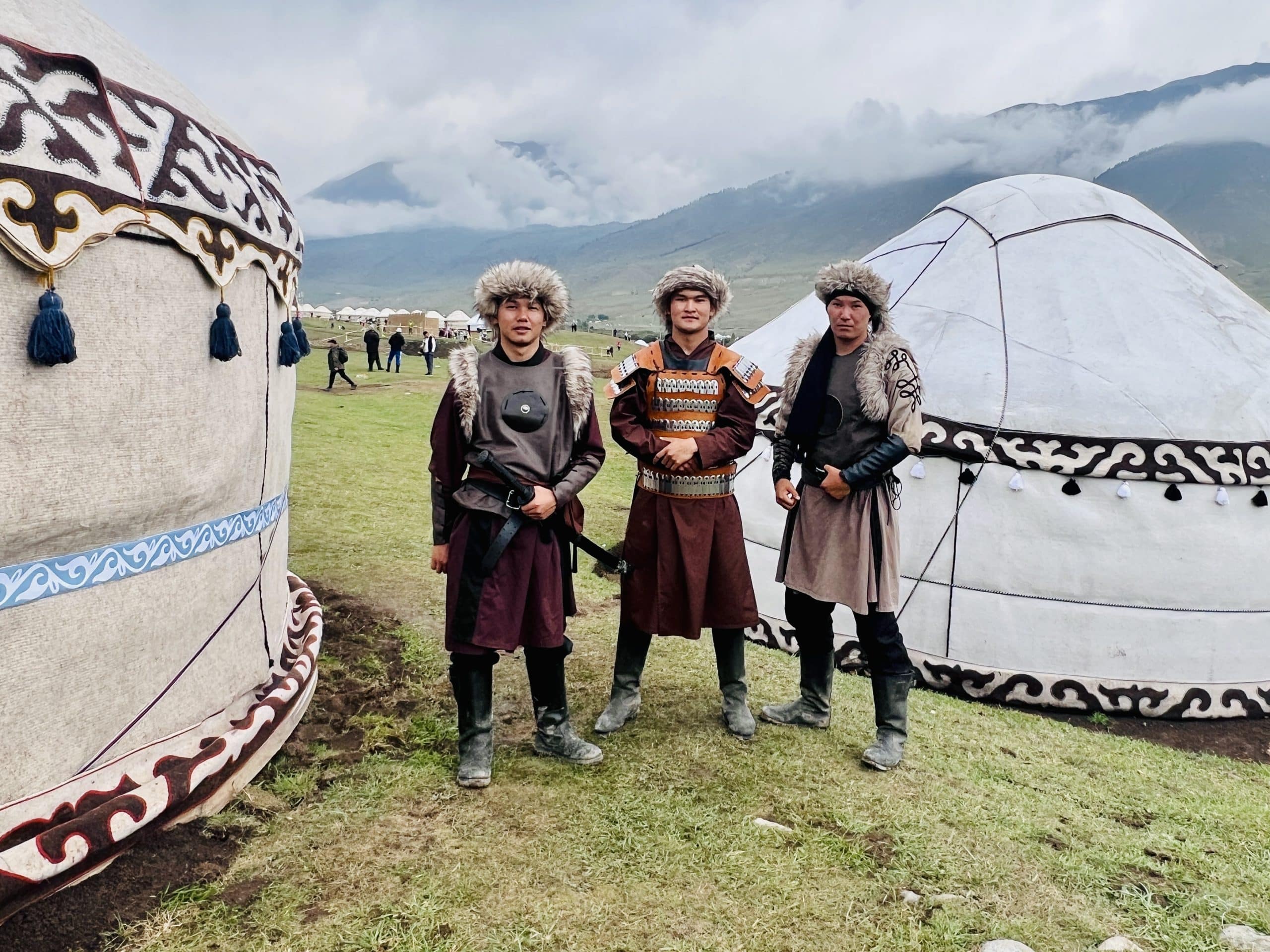
Kyrchyn Gorge is a large open plain up in the mountains, a hop, skip, and a jump (OK, a big hop, as these mountains are high) from the Kyrgyzstan border with Kazakhstan. Nothing. Once there, nothing can prepare you for the sight of the Köchmöndör Aalamy Ethno-Village (translating as “Universe of Nomads”), the primary cultural and ethnographic venue for the World Nomad Games. There were hundreds of yurts on the skyline, filling the valley as far as we could see.
And there was an extra little burst of elation as we arrived. While we were now strolling into this extraordinary nomadic encampment, we knew that many of our fellow competitors – sorry, spectators! – were still battling their way onto buses and fighting for an inch of space to get up the mountain.
We had made it.
And what we’d arrived at was extraordinary.
And you needed your walking shoes. This place was HUGE.
14A Nomadic City Comes to Life

The bazaar inside the Games village had been constructed using traditional building materials, creating an ancient nomadic settlement. For a moment, it was as though we’d wandered onto a movie set, but as it filled with visitors from across the lands and across the world, it felt less theme parkesque, more very definitely Kyrgyzstan.
13The Food Bazaar

You will never go hungry in Kyrgyzstan, even when you are up a remote mountain gorge. Inside the bazaar, a labyrinth of paths and the irresistible smells of food wafting from endless eateries. Pretty much everywhere you go, you have the option to try Plov, which you find being stirred in large iron cauldrons. It’s a perfect rice dish with meat (usually lamb or beef), grated yellow carrots, and onions, designed to feed the masses.
Coffee and Cake worth a mention
We emerged from the ‘give me strength’ bus situation, uttering the unlikely words, “get me a coffee.” How extraordinary then to stumble upon the fabulous Konti Pastry from Bishkek. With a stall hidden deep in the Bazaar selling some irresistible desserts. Yes, I know it’s probably sacrilegious to choose a coffee and cake over the more traditional offerings elsewhere, but this wasn’t just any old pastry shop.
I squished onto a table to enjoy my pudding, next to a Kyrgyz family who happily moved together to make room for me, yet another one of those wonderfully warm and spontaneous moments that kept happening throughout our time here. Mr Wren, whilst waiting for his coffee, got chatting with the owner of Konti; and it was then we discovered that her team had been working on something rather more spectacular than the cakes in front of us.

They had created the extraordinary welcome cake for the President’s visit. Not any old fruit cake but a towering, almost two-metre-high, seven-tiered creation weighing around 220kg and large enough to serve more than 2,000 guests. Each tier represented one of Kyrgyzstan’s seven regions, decorated with mountains, pine forests, golden eagles and ibexes, and topped with a snow leopard.
It took 1,200 eggs, 100kg of chocolate sponge, 150kg of chocolate cream and 24kg of Belgian chocolate to create this edible masterpiece. And there we were, sitting at their little pastry shop tables, enjoying coffee and cake and chatting to the very people who had made it.
You can see it here:
12The Cultural Ethno Village

Without much of a plan, we simply wandered through Kyrchyn Gorge, ducking into whichever of the 15 yurt towns caught our eye. Each represented one of Kyrgyzstan’s seven regions, the major cities of Bishkek and Osh, and various international and public organisations. We even found a yurt flying both the American and Kyrgyz flags, representing the Bishkek Maker Space Centre.
It was fascinating to hear how strongly people connected with their heritage. We found the Kyrgyz people are very aware of their roots and can trace their ancestry back to one of the country’s original 40 tribes. Time and time again, we were invited inside the yurts to join a banquet. The feast on offer was completely free of charge.
One of the loveliest parts was meeting and chatting with the locals. We met Aidana and her family and friends, whose fabulous English was a real surprise. She had studied abroad and happily stood chatting with us in the rain, sharing a little about her life and experiences. Conversations always seemed to start naturally at the World Nomad Games, and these conversations were every bit as memorable as the spectacle around us.
With so much to see, taste and experience, knowing where to go next was almost impossible. So we simply followed the music, the dancing and whatever caught our eye, and it turned out to be the perfect way to explore Kyrchyn Gorge.

11Living Heritage Programs

We paused at the main stage and applauded enthusiastically as the Bishkek region won the speed yurt building race; we saw a mass of archers firing off arrows into thirty targets; we saw Tug of War and mas-wrestling, or tayak tartysh, a Stannis equivalent of arm wrestling where you and your opponent hold onto a relay baton and have to pull each other over a wooden plank … and I tell you, these multinational power lifters were big guys!
10When the Olympic Spirit Disappeared, something more magical appeared

After all too short a time, we decided to head back down the mountain to catch the action at the hippodrome and sports centre…
The Bus Battle continued…
It was time to find a bus back down the mountain. Here, the Olympic spirit evaporated, and the traditional warring nature of the nomad ancestors, dating back to Genghis Khan, came to the fore. Thousands upon thousands, ok hundreds upon hundreds of men, women and children trying to enter onto far too few buses. It was perhaps not the time to reflect on whether this event was a victim of its own popular success, nor to let me be the first to shout “PLEASE! Form an orderly queue!”, but it was chaos.
However, I didn’t get to where I am today without my own nomadic skills in catching Asian buses. Happily, I managed to cling to a doorway of a turning bus, get on, and find a seat, but it was not the best experience; children were crying, families were complaining to each other, there were words, which even when you understood nothing, you knew it was not polite!
I tell you, sweet as the people of Kyrgyzstan are, once upset, there’s a core toughness and a whole other personality comes out. You’d seriously never want to cross a Kyrgyz woman…
9Rescued by the Doctor

I was the only one of our group who made that bus. Once back to where we’d abandoned the car, and with nowhere to sit amongst the chickens and dirt, I paused on the steps of a nearby doctor’s surgery, and took a breath. A doctor appeared in the doorway and insisted I could come indoors, and directed me to wait on her examination bed in her Consultation Room; she even brought me a pillow and offered me water.
With no English, she showed me photos of her daughter at Disneyland, and I showed her a photo of a kangaroo – “not America; I’m from Australia.” I managed to make myself understood. We shared photos of our granddaughters, and I showed her the last photo I had of my husband in his Kyrgyz hat before the bus pulled away, leaving him up the mountain. She sighed; she understood.
8Mission: Get Down the Mountain
So whilst I was having a very Zen Wren moment, Mr Wren was experiencing quite the opposite. There were screams, tears, frustration and more than a few hair-raising moments that would fill the next hours as he attempted to board an already overloaded bus.
At that point, when they announced a women-and-children-first policy, things looked so desperate that he and our guide even considered hiring two horses and riding back down the mountain. Although it would have been a great story and by now I had befriended the local doctor, if anything had gone wrong I’m actually rather glad they didn’t. The proposed ride would take around 90 minutes down a pretty stony track, and the quoted price was US$100.
Clearly, the ancient Silk Road trading instincts are still alive and well!
Eventually, Mr Wren arrived; we think his height and the fact that he was sporting a Kyrgyzstan hat gave him some kudos in the bus furore scramble! Our local guide had no such luck and was still stranded up at Kyrchyn, not appearing for several more hours.
And so our great escape from the World Nomad Games continued…
7Hitchhiking, Kindness and a Race to the Kok-Boru

Just as we were trying to work out what to do next, being marooned in the middle of nowhere. we were offered a lift. A very nice lady with a smart car, who had driven all the way from Bishkek to show a very unimpressed teenage son the delights of the Nomad Games, gave us a ride. The hour-long ride back to Cholpon-Ata showed us a different side of Kyrgyz life: a fancy car, a moody kid who could hardly tear his eyes away from his mobile phone (no different to kids we see back home!), and a delighted corporate Mum happy to chat about what we’d enjoyed at the Nomad Games.
Now, normally we’d not jump in a car with strangers, but we were so grateful to find someone with great English going our way that we didn’t think twice. We heard plenty of people do manage to hitchhike their way around Kyrgyzstan very successfully, and here we were back to our youth, hitching a ride something we last did in Botswana in 1991!
Five hours, three minibuses, a lot of patience, and some stories to tell. The carefully planned World Nomad Games itinerary had officially gone out the window.
Somehow, it didn’t matter. Because somewhere between the bus chaos, the proposed horse escape plan, and the kind strangers, we’d experienced something far more memorable than simply watching a sporting event.
We’d experienced a little of the nomadic spirit for ourselves — resourcefulness, resilience, hospitality and an extraordinary willingness to help a stranger.
Kok-Buro
6Wait, is Kyrgyzstan Playing the USA?

After we were dropped back at the Hippodrome, we legged it straight to the Kok-Boru stadium. Somehow, we made it just in time to watch the last two matches
It’s a funny old life, having started the day unsure whether I wanted to watch this barbaric-looking sport. I find myself elated to be there. Kok-Boru is essentially polo, where the aim seems to be to ride your horse and score goals by carrying a headless goat carcass that must be placed in an oversized dog bowl.
It seemed even more exciting to find that the match was between the Kyrgyzstan national team and their opponents, the USA! This was a big match, if a little one-sided!
Since when did Americans start playing ancient Central Asian games involving mutilated goats?
Mind you, nothing should surprise us nowadays!
5Kok-Boru: The Sport You Have to See to Believe

Kok-Boru really is all action and so tough! The horsemanship in a very physical game is astounding, and the strength required is immense. It was a Godzilla of a goat they were playing with; someone told us it weighed over 20 kgs, so lifting it off the ground was a massive test of strength and agility.
If you’ve never seen Kok-Boru before, it’s difficult to explain just how extraordinary it is.
Imagine several horsemen racing at full speed, battling for possession of a goat carcass as they try to get it into the opposing team’s goal.
Now imagine doing that while controlling a horse.
It is physical, tactical and incredibly fast.
.To an outsider like me, Kok-Boru might look completely bonkers, but across Central Asia it has deep cultural roots and demands extraordinary horsemanship, strength and skill. I arrived expecting to feel revolted; instead, watching this ancient sport played on an international stage became one of the highlights of our time at the Games. Kyrgyzstan won, as expected, but the USA gave them a good run for their money and scored several goals.
And then came the bit I really wasn’t sure I wanted to hear: apparently, the winning team eats the well-tenderised goat at the end of the competition? Is that true? Someone, please tell me that’s just a fable?
But seriously, that’s the magic of the World Nomad Games. They whisk you into another world where almost anything can happen, and somehow, absolutely everything seems believable!
4One Day Was Never Going to Be Enough

As hunger took over and our guide and driver finally (after 5 hours) made it back to Cholpon Ata, we headed out for dinner having had a day rich in culture, sporting endeavour, and raw human emotion that will long live in our memories.
The games continued for several more days, but sadly we needed to return to Almaty for our onward travels; we definitely should have allocated more time to the World Nomad Games. By all accounts, in the following days, transportation became easier, and there was so much more to see.
Why the World Nomad Games Matter
The more time we spent at the Games, the more I realised that this wasn’t simply a quirky sporting event.
It is about identity.
It is about preserving traditions that could easily disappear in a rapidly changing world. And it is about bringing people together.
The Games were also a wonderful reminder of one of the reasons I love travel so much. You can plan the itinerary, book the hotels and research the sights, but you can never quite plan for the people you’ll meet, the moments you’ll stumble upon, or the experiences that stay with you long after you’ve gone home.
And then, occasionally, travel throws something completely unexpected at you.

3Kyrgyzstan Beyond the Games

Of course, the World Nomad Games were just one part of our time in Kyrgyzstan. We’d already been travelling through this extraordinary country, from Bishkek to the mountains and around Lake Issyk-Kul. And the Games gave us another perspective.
We weren’t simply sightseeing.
We were seeing Kyrgyzstan celebrating itself, meeting people who had travelled huge distances to be part of it, watching ancient traditions come alive through a new generation, and seeing international athletes embrace sports rooted in Kyrgyzstan’s nomadic past.
That felt pretty special.
Would I Recommend the World Nomad Games?
Absolutely.
If you have even the slightest interest in culture, history, horses, traditional sport, or simply seeing something completely different, put the World Nomad Games on your travel radar.
Looking back, the World Nomad Games gave us far more than we expected.
We came for the spectacle, the horses, the competition, the traditions and the incredible setting. But what stayed with us most were the people: the families who travelled for 19 hours simply to be there, the volunteers who kept smiling through the chaos, the strangers who stopped to help us, and the athletes proudly representing their countries.
It wasn’t always easy. We queued, we waited, we got lost, we hitchhiked and occasionally wondered quite what we had got ourselves into!
But perhaps that was the point.
Travel rarely goes exactly to plan — and sometimes those are the moments you remember most.
The World Nomad Games gave us a glimpse of Kyrgyzstan that was proud of its past, celebrated its traditions, and opened its doors to the world.
And honestly? I’m very glad we got to be there.

2Final Thoughts
In a world where sporting events can sometimes become another arena for political division, it was refreshing to see such a diverse gathering come together under the banner of sport and culture. Here, countries weren’t defined by politics or power, but by their athletes, traditions, and willingness to participate.
There was something rather uplifting about thousands of people from different corners of the world meeting in Kyrgyzstan to compete, cheer each other on, share food, music and stories, and simply celebrate what we have in common.
Perhaps the world could do with a few more gatherings like this, where the starting point is not what divides us, but what brings us together.
It’s a pursuit we wholeheartedly support, and judging by the estimated 100,000 people attending each day, we certainly weren’t the only ones. For a few days in Kyrgyzstan, people from across the world came together to compete, celebrate, cheer, share their cultures and, perhaps most importantly, simply enjoy being together.
And really this feels immensely special.
Thank you for reading until the very end. I realise this was an epic post, but boy was it an epic event. Thank you so much to all the wonderful people we met along the way who helped make our Nomad Games unforgettable
1World Nomad Games 2028

Thinking, “I want to see the World Nomad Games for myself?” you’ll have your chance in 2028, when the Games head to Kazan, in Russia’s Republic of Tatarstan – the dates are still to be announced.