Would You Watch Eagle Hunting in Kyrgyzstan?
Seeing an eagle-hunting demonstration is on the agenda for practically every tour that touches down in Kyrgyzstan. I must say we were conflicted on whether we should go and watch.
Was it right to go and support an activity that sees golden eagles, the most majestic of birds, taken from their nest at a young age, and kept tethered, hooded and hungry for the satisfaction of curious tourists? Put like this, the answer is perhaps an easy no, but as is often the case, we found a complex dilemma.
So, did we go? Spoiler alert: we did, but not without a fair bit of soul-searching…

Should You Book Eagle Hunting?
I was keen to see the tradition. Mr Wren, our zoology graduate, was unsure he wanted to support this with our tourism bucks. The trouble with the whole decision is that it is hard to know whether you are making the right personal call until you have all the facts. Part of the way to gain these facts is to go, learn and see for ourselves. It’s a dilemma.
We certainly appreciate that Responsible Tourism is all about supporting local businesses, and we understand eagle hunting is a local tradition that might otherwise die out without the tourism support. This was one example in which our money seems to go directly to supporting the locals. But do they have the birds’ welfare at heart?
When animal welfare is involved, it is a complex question rooted in many years of history. Eagle hunting dates back many centuries. We have had this dilemma before, trying to work out how to support elephant sanctuaries in Thailand.
What Is Eagle Hunting?

Meet the Berkutchi of Kyrgyzstan
A berkutchi is a traditional master eagle hunter in Kyrgyzstan who trains and hunts with golden eagles. These nomads have been hunting with these raptors for hundreds of years; it is how they catch animals for food and fur. This is indeed what they do during the winter, when the tourists disappear, and the demonstrations stop.
How Do They Get the Eagles?
The eagles are taken from their nest at 2 months old. Normally they will fledge some months after this, so the hunter and his (yes, we only saw men handling the eagles) family have to quickly become the eaglet’s family. Taken so early means they are easy to train. Only females are selected because they are bigger, better, smarter, and more obedient trainees.
Training the Eagles
It takes over a year to train an eagle to hunt, so they really do become part of the family. Eagles are used to hunt wolves, foxes and marmots. Apparently rabbits are too agile, so they are rarely preyed upon.
They have amazing eyesight, able to see up to 5 kilometres away. It’s all a bit gruesome, but their hunting strategy involves sinking their talons into the victim’s neck and pecking their face.

Where We Watched: Finding a Demonstration
We signed up for a private eagle-hunting demonstration in Bokonbayevo. Not that we are lazy, but the decision was helped by the fact that the demonstration area, a grassy open plain with little hills from which the eagles fly, was a stone’s throw (over the cemetery) from our accommodation.
The details
- Booking: Arranged by our tour guide, also available via the local village Guest Houses or the CBT Bokonbayevo (Community Based Tourism) office.
- Cost: 5,000 KGS (11 USD)
- Duration: Just under an hour.
- What’s included: The call demonstration, the prey simulation, have-a-go archery and a photo op.

The Eagle Hunting Demonstration: What Actually Happens
First Impressions: Welcome to the Set of a Dracula Film
We turned up, and our first impression was that we had rocked up on the set of the latest Dracula film. One of the demonstrators was frantically trying to stem the flow of blood from his neck while trying to pretend nothing of interest was going on. Apparently it was just a little scratch from one of the rapier-like talons, but it certainly served as a graphic reminder, if any were needed, about just how effective these killing machines are.
The Demonstration: An Eagle at Our Feet
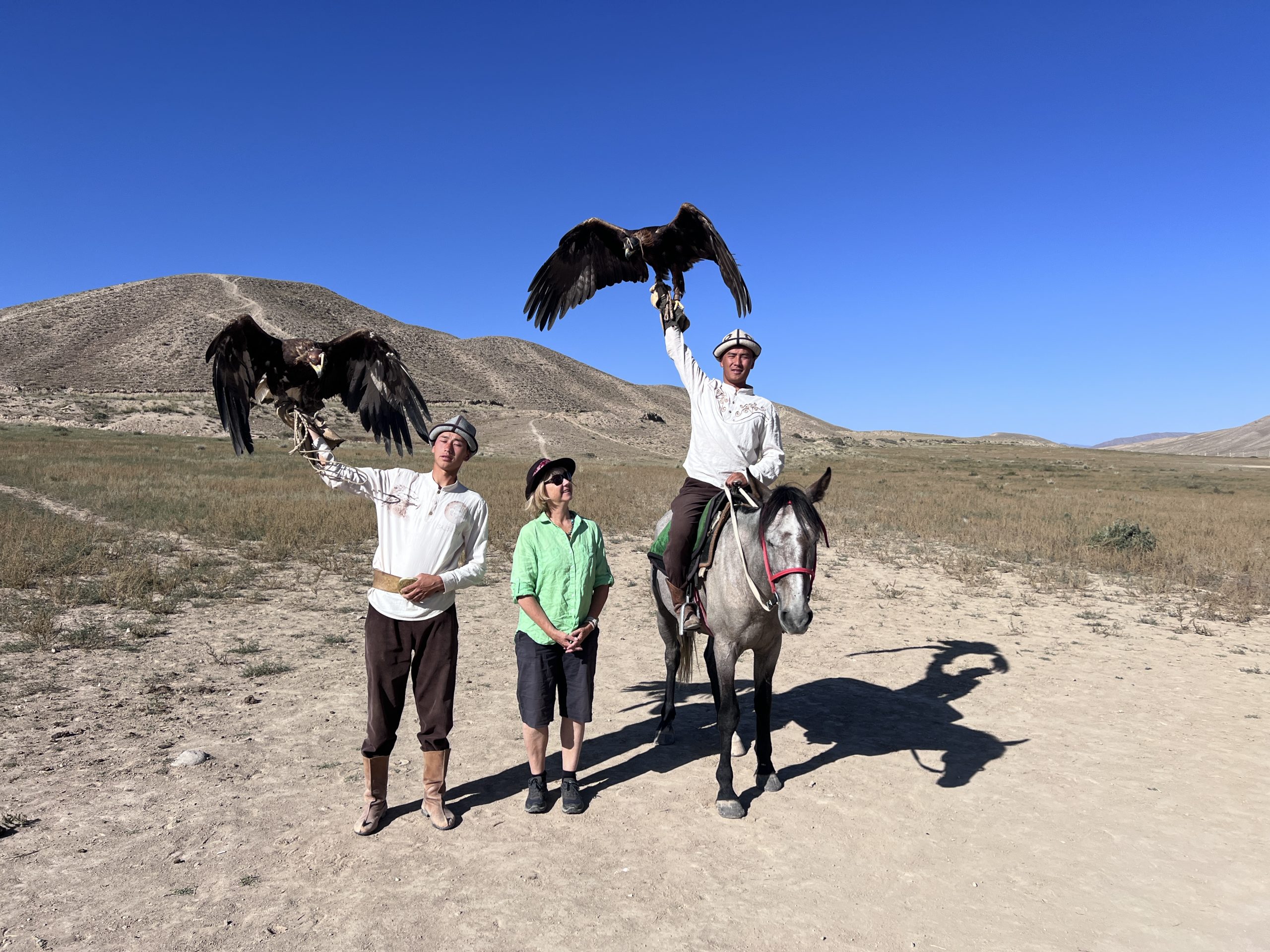
For the demonstration, one of the brothers (our demo was done by three brothers) headed off on horseback into the distance, an eagle on his arm, and rode up a hill a good distance from where we were standing. The bird flew from the hill point to one of the handlers, who had an outstretched arm holding meat.
This was then repeated with a second golden eagle. Another brother, dragging a fox skin behind him, started running about 100 metres from us. We wondered what was going on…. The bird soared in the distance and then gracefully started flying towards us. Milliseconds later, the guy with the fox skin was running past us, and this huge eagle landed on the fox skin at our feet. The timing was immaculate!
Only problem… don’t ask me for the photos. One moment the eagle was a speck on the horizon; the next, it was at our feet, amid a flurry of feathers, with the fox skin in its talons. We were all too busy avoiding getting a massive slap from an axe-like wing.
It may sound a bit macabre, but the display did make you wonder what a real hunt would look like. We were told the Government no longer approves demonstrations involving real prey. We are not sure we would have had the stomach for it….

The Finale: Archery Masterclass
The demonstration ends with the chance to join for an archery masterclass. The guys make it look easy, hitting the target, which is a paper Ibex, with ease. All we can say is that if we were playing pin the tail on the donkey with our shots, we were not far off. We’d say the local Ibex can rest easy with us around!

The Nomads Behind the Birds
The three brothers, and they were clearly at ease with these formidable birds. Eagles are deeply respected as “birds of God”; they aren’t simply pets or performers to them. The eagle becomes part of the family, and that bond between hunter and bird is the heart of the tradition.
The demonstrations also provide livelihoods for many people who otherwise would have to give up their traditional way of life.
Is Eagle Hunting Ethical? A Look at Animal Welfare
What the Hunters Told Us
The brothers are well practised in handling questions about whether eagle hunting is ethical and sustainable in this day and age. Their position is that eagle hunting remains an important part of nomadic culture and provides food and clothing in winter.
When challenged on animal welfare, they insist that the eagles are very well cared for and are always reintroduced into the wild after 15-20 years, so they can mate, reproduce and live their ‘natural’ lives for the next 30+ years, over a 55-60-year lifespan. People always check that the eagles are flourishing after being released.

Can We Believe It? What Our Research Found
It is difficult to validate this, as our quick online research indicates that a female golden eagle can have chicks from age 5 and that the lifespan of golden eagles in the wild is around 25-30 years (in captivity, they can live 10-15 years longer). This would indicate that a hunting eagle would miss a significant part of its reproductive phase.
Moreover, golden eagles mate for life, so we wonder whether an aged female raised by humans will find it easy to find a viable long-term mate. We don’t have answers to this debate.
Is It Ethical to Watch? It’s a Line Call
It’s a dilemma. Bottom line, many visitors will, and there is no doubt that the process is highly sanitised with a focus on the care of the birds. Is an eagle different from a horse or a dog, recognising that cultures and histories are different? I’d say yes because horses and dogs have been domesticated for hundreds of years, whereas eagles are still wild and will always be, and are only brought into a domesticated environment temporarily. That said, I recognise it’s a line call.
Our Verdict: A Guest in a Far-Off Land
I also personally always try to start from the viewpoint that I am a guest in a far-off land. I’m here to learn and understand. I can’t always readily suspend my judgement with things I see around the world, much as I try. This time, from what I saw, I was comfortable attending the demonstration. In fact, it was one of the memorable highlights of the trip. I would go again!
Tips Before You Go: What to Wear, Bring and Ask
If you decide to go, here’s what I learned from our visit:
- Check that a demonstration is on. They stop in winter (November to February) when the hunters head out with their birds.
- Wear sensible shoes and layers. You’ll be standing in an open field, and mountain weather changes quickly.
- Don’t stand too close when the eagle lands. I speak from experience of being walloped by an eagle’s wing!
- Ask questions. Ask how the eagles are cared for, how long they’re kept and what happens when they’re released.
- Think before volunteering to hold one. They’re heavier than they look, so be ready for a wobbly arm.
- Bring a friend to film. You’ll see why in the next section.
Photography Tips (From a Wren with an iPhone)
My motto has always been that anyone can have this experience and take these photos.
Well, this time the photos were not my best. Which is why I’m happy to have met Mandeep from Pinks Photography, whose incredible attention to detail in his photography captures the elegance and grace of the golden eagle. Thank You, for your stunning up-close photos taken during the World Nomad Games.
Do follow Mandeep on IG at @p7nk.s.

What Went Wrong: A Wobbly Mess
Here’s what went wrong. One moment, the eagle was a speck on the horizon, and the next, it was at our feet. It all happened so fast. Thank goodness I’m not a Marmot in these here lands; I also wasn’t prepared for how heavy the birds are to hold out at arm’s length. The females can weigh up to 7 kg, so my chances of a steady photo with a spread-eagled pose were a wobbly mess.
Horse and Eagle: Juggling Both
Not only that, you are invited to be photographed while on a horse. Even getting mounted wasn’t as easy as I remembered from my childhood pony club days. This time, I’m trying to juggle an eagle metaphorically, too. Well done to all of those who managed the fabulous photo shoot; that’s all I can say.
Mr Wren Opts Out
Then I had Mr Wren saying, “I ain’t having my picture on record with a captive eagle”. So, with all this, we end up with our best photographer on the horse, without the strength to hold the bird alone, and only one attempt at getting one half-decent photo. You can see how easily this all goes wrong, dear readers! (I know, I know it’s not all about the photo, but this is certainly one of those iconic Kyrgyzstan photo opportunities!
Here’s our effort below…

What I’d Do Differently
Here’s what I’d do differently:
- Switch to video or burst mode. The eagle won’t wait for you to focus, and video lets you pull a still frame afterwards.
- Aim at the landing spot, not the hill. Be ready before the eagle launches.
- Plan ahead for the eagle-on-horse photo. Holding a heavy bird with a shaking arm is hard; be ready for that one moment the eagle spreads its wings
- Look for the quieter moments. Close-ups of the eagle’s face, the talons and the handlers’ hands are easier to capture and often the best shots.
- Shoot a wide scene first. The mountain backdrop and the horse and rider set the scene for the story.
- Be kind to yourself. Not every day produces a gallery. Sometimes the best memory is not the one on your phone

So, Would You Go? My Verdict
The golden eagles are truly spectacular. Their speed, hunting intelligence and sheer size are impressive. The demonstration was a great opportunity to learn more about these birds, understand their importance to the nomads, see them in action, and perhaps become more knowledgeable.
It is genuinely hard to assess in such a short period whether this is a not-to-be-missed experience and a rare opportunity to meet the local berkutchi and see these magnificent birds of prey up close. Or whether you should give it a miss.
I’m genuinely glad I went, and even Mr Wren said he was too.
So, would you go? Tell me in the comments!
Happy Wanders! xx

Joining Saturday’s Critters with many thanks to Eileen; enjoy the other blog posts you will find here.
If you have enjoyed this, you might also enjoy:
Writer Bio: Jenny Littlewood is the writer and photographer behind Little Wandering Wren, an award-winning travel blog. She has lived in Singapore, Hong Kong and Thailand and writes about memorable stays and worldwide wanders, with a soft spot for comfort-meets-adventure travel for the over-50s and young at heart. She visited Kyrgyzstan and the World Nomad Games in August 2026 with her husband, Mr Wren, a zoology graduate with an active interest in animal welfare. Follow her adventures on Instagram @littlewanderingwren.